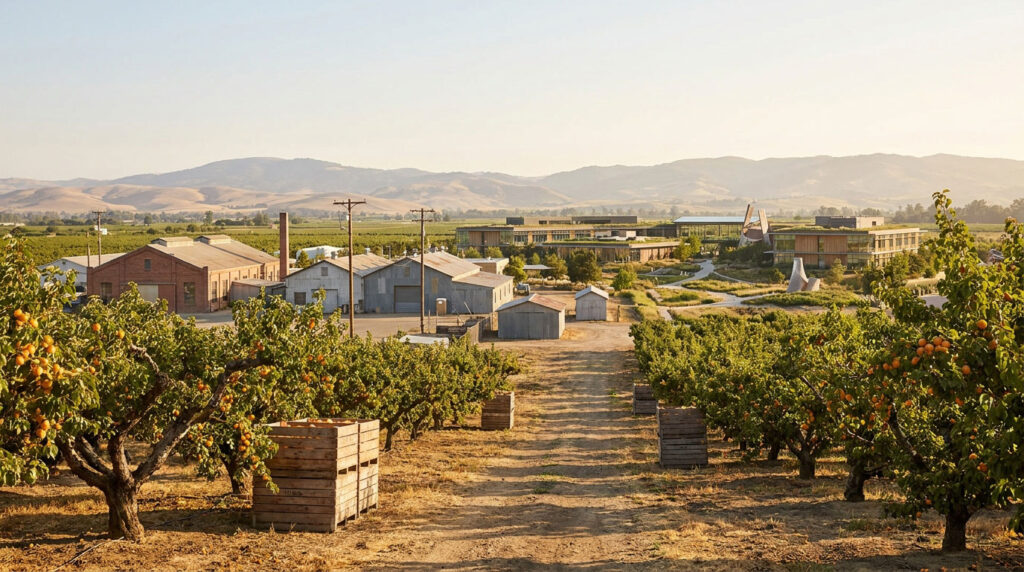
Sunnyvale history is often summarized as a journey from fruit orchards to Silicon Valley. That description captures a remarkable transformation, but it leaves out the factories, aerospace programs, neighborhood businesses, and workers who connected those worlds. The city’s modern identity developed through overlapping industries, not one sudden replacement of farms with computers.
Today, that history raises a practical question: what should a technology city preserve? Sunnyvale’s Orchard Heritage Park Study connects the community’s agricultural past with decisions about its future. Understanding how the city changed helps explain why a surviving apricot orchard still matters.
Before Silicon Valley: Sunnyvale’s Orchard Economy
Long before technology campuses became part of the local landscape, orchards helped shape Sunnyvale’s economy. Fruit growing involved more than attractive rows of trees. It connected cultivation with harvesting, processing, transportation, and the businesses that supported agricultural work.
The Sunnyvale Heritage Park Museum’s orchard history records that the City preserved ten acres of Blenheim apricot trees in 1994 to recognize agriculture’s contribution to local development. An interpretive exhibit added in 2001 explains orchard workers’ lives and the cultivation and canning of fruit during the first half of the twentieth century.
Preserving this evidence prevents agricultural history from becoming only a nostalgic picture of spring blossoms. The interpretive exhibit includes early cultivators and ranching equipment, offering a reminder that farming required tools and organization. For readers exploring the past, such objects are useful starting points for understanding how people worked, rather than simply how the valley looked.
A Town Beyond the Trees
The orchard landscape was also a working community. Looking at tools, business records, and photographs changes the questions we ask. Who maintained the equipment? Where did families buy supplies? How did a harvest become a product that could leave the valley? These questions connect agricultural history with the growth of a town.
Murphy Avenue and the Railroad
According to the museum’s history of downtown Sunnyvale, present-day Murphy Avenue was once Main Street, a dirt road leading to the railroad stop in the settlement called Murphy’s Station. Early businesses included a general store, postal services, and a drugstore. The museum’s collection also documents cannery activity and other downtown enterprises.
Remembering the Work Behind the Harvest
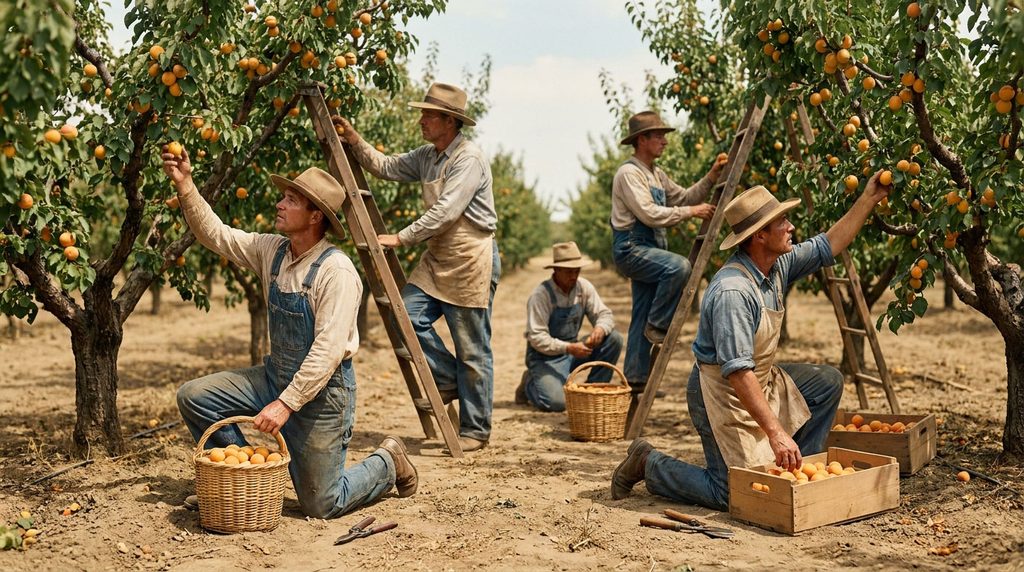
Seen together, these records suggest a more useful picture than an empty countryside waiting for development. Sunnyvale already had commercial relationships, practical skills, and a community organized around work. Its agricultural chapter deserves attention on its own terms, not simply as the opening scene in a technology success story.
Heavy Industry Changed the Direction of Sunnyvale
A major turning point followed the 1906 San Francisco earthquake and fire. The Joshua Hendy Iron Works moved its manufacturing operation to Sunnyvale, with construction beginning in October 1906. The Hendy Iron Works Museum’s plant history describes production that expanded across mining machinery, irrigation equipment, shipbuilding components, and other industrial systems.
During World War II, the plant produced propulsion engines for Liberty ships. Westinghouse purchased the operation in 1947. This history complicates the familiar orchard-to-computer narrative: large-scale manufacturing was an important intermediate chapter. Sunnyvale’s industrial past included substantial machinery and national defense production, not only the smaller electronic devices associated with Silicon Valley.
Westinghouse’s later product lines included wind tunnels, radio-telescope mounts, and fruit-packaging machinery. That range is revealing: older agricultural activities and newer scientific industries did not occupy completely separate worlds. Equipment makers could serve both. Thinking in terms of overlapping uses helps explain the transition more accurately than imagining a clean break between an orchard era and a technology era.
Aerospace Added Another Layer
Nearby Moffett Field adds context to that aerospace chapter. NASA’s historical archive preserves 1933 newsletters from U.S. Naval Air Station Sunnyvale, the installation later known as Moffett Field. That record places aviation activity decades before the commercial computer boom and shows why a history focused only on software would overlook an important part of the region’s technical development.
Lockheed’s arrival in 1956 further changed Sunnyvale. The museum’s account of Lockheed’s local history identifies that arrival as a transformative event for both the city and the Santa Clara Valley. Aerospace belongs near the center of this story, rather than appearing as a footnote before the computer era.
Tracing these industries together reveals continuity in Sunnyvale’s identity as a place of technical work. The products changed dramatically, but the history remained rooted in people designing, building, testing, and improving things.
Semiconductors and Consumer Technology
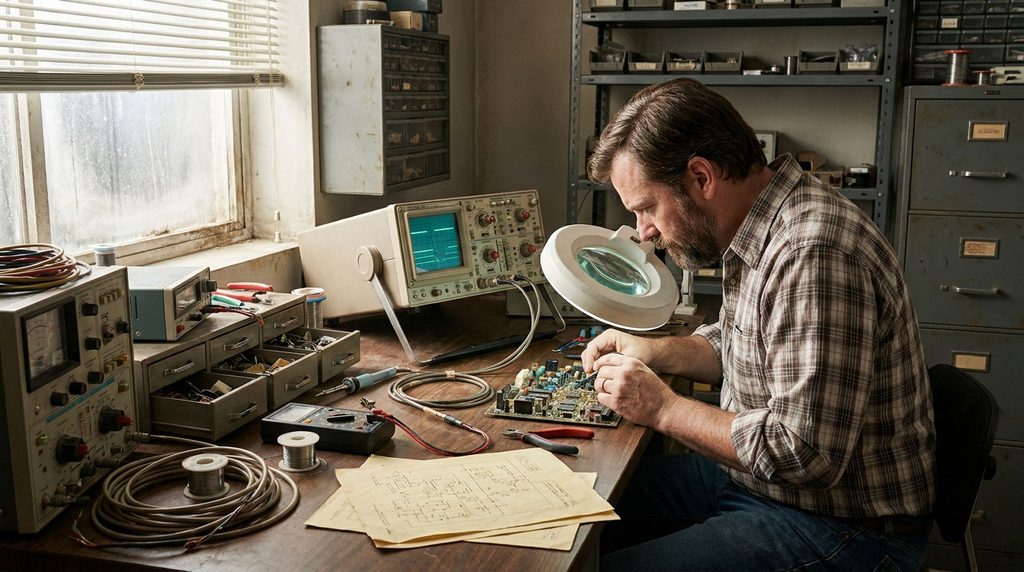
The museum’s industrial exhibits identify silicon-chip design and manufacturing in the 1970s as central to Sunnyvale’s technology transformation. Later internet businesses added another chapter. These developments help explain why the city’s history cannot be reduced to a single company or invention.
One particularly memorable example came in 1972, when a Pong prototype was installed at Andy Capp’s bar in Sunnyvale. The Computer History Museum documents that original machine and its role in the growth of arcade gaming. A local gathering place became part of a much larger change in entertainment.
Why Orchard Preservation Matters in 2026
The orchard-to-technology story is not finished. In a February 4, 2026, announcement, the City reported that longtime Heritage Orchard operator Charlie Olson planned to retire. It noted that he had maintained the orchard under contract since 1977 and was planning to end his role in mid-April.
Separately, the City’s orchard study examines long-term operation and maintenance, alongside boundaries for a potential museum expansion. These are planning questions, not evidence that the orchard has been approved for redevelopment. The distinction matters when discussing the future of a place with strong community meaning.
Preserving an orchard also means deciding what its history should communicate. Trees can make the agricultural landscape tangible, while interpretation can explain the labor and businesses behind it. Neither replaces the other.
Preserving More Than One Version of the Past
Sunnyvale’s Historical Context Statement Update seeks greater recognition of Asian American and other minority contributions. Its goals include identifying places associated with those histories. That approach encourages readers to look beyond prominent employers and landowners when considering who shaped the city.
The museum is revisiting technology history, too. Its May 2026 Tech Wall update describes plans to accommodate more recent decades and add information through QR codes. Even comparatively recent inventions need documentation as devices and workplaces change.
Understanding Sunnyvale Through Its Changing Work
From orchards to Silicon Valley, Sunnyvale’s transformation is best understood as a connected history of agriculture, manufacturing, aerospace, and technology. Each chapter gives the next more context. Explore Sunnyvale History with that perspective: a fruit tree, an industrial building, and an early circuit board can all help tell the story of the same city.