
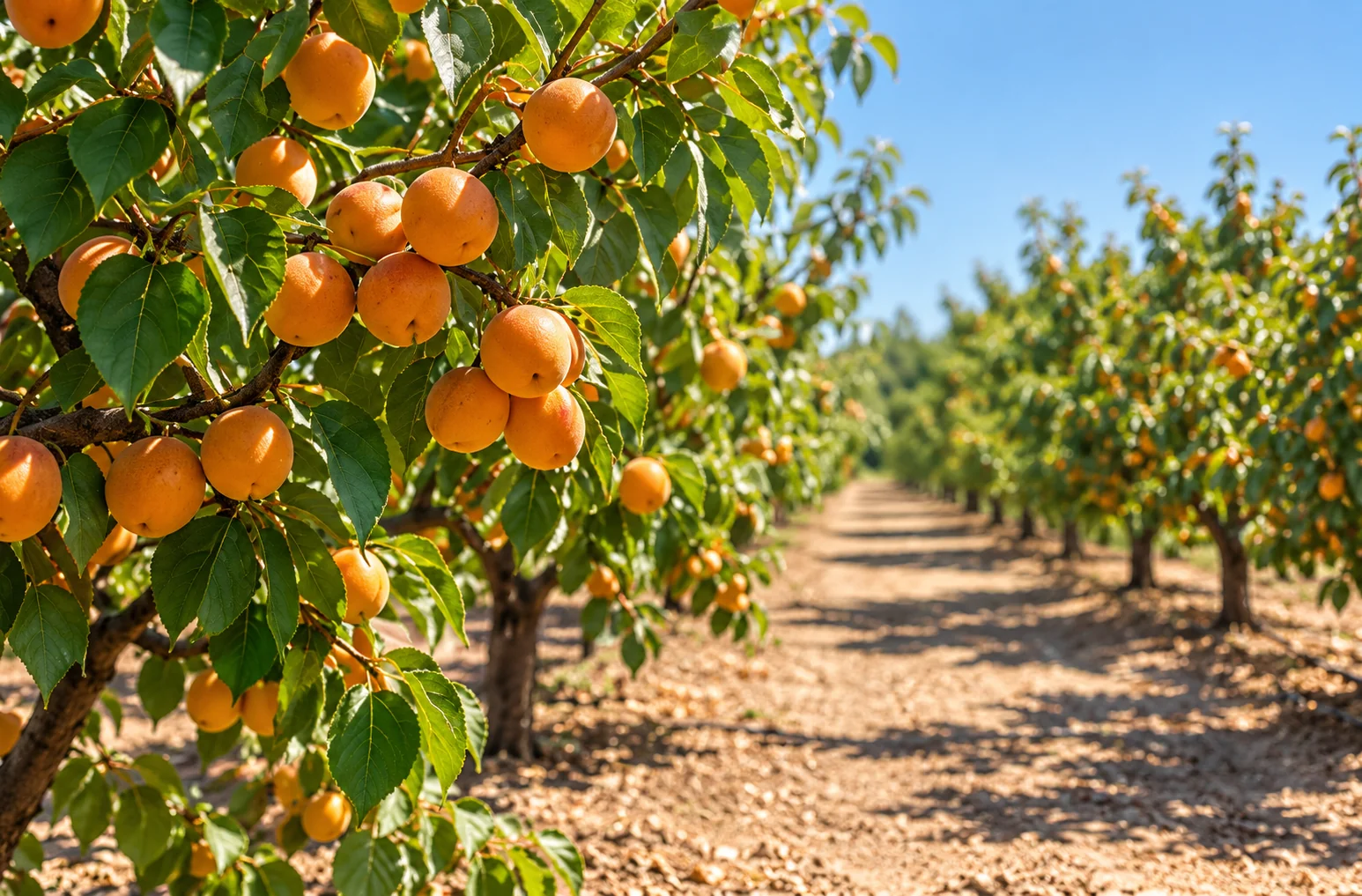
Apricots offer a different way to understand Sunnyvale. Instead of beginning with office buildings or technology companies, begin with a tree: its blossoms, its short harvest, and the people needed to bring its fruit to market. Sunnyvale apricot history connects the landscape to work, family memories, and decisions about what a growing city chooses to preserve.
The fruit matters because it makes those connections tangible. An orchard is both a place to enjoy and a place that required planning, skill, equipment, and sustained care. Looking beyond its beauty reveals a city shaped by much more than a simple transition from farms to offices.
A Living Connection to Sunnyvale’s Orchard Years
The Sunnyvale Heritage Park Museum’s orchard history records that the City preserved ten acres of Blenheim apricot trees in 1994. An interpretive exhibit followed in 2001, presenting orchard work and fruit processing alongside examples of agricultural equipment.
These details explain why the orchard deserves more attention than a quick photograph. Its value lies in the relationship between living trees, tools, and interpretation. Together, they help visitors connect an attractive landscape with the practical demands of earning a living from it.
Why the Blenheim Name Matters
Blenheim is a particular apricot variety, not a name for every apricot grown locally. The UC Master Gardeners of Santa Clara County include it among varieties suited to the area. Their guidance places the local harvest broadly in June and July, depending on the variety.
That seasonal window gives historical questions a useful focus. When did workers need to be available? What happened when fruit ripened quickly? How did households balance orchard responsibilities with other employment? A familiar fruit becomes a starting point for understanding the calendar of everyday life.
A Variety Is Not a Complete History
A cultivar name cannot identify who planted a particular tree, worked an orchard, or owned the land. Those details require records. Keep the fruit’s horticultural identity separate from the history of a specific property or family.
The Work Behind the Harvest

A useful way to read an orchard photograph is to look away from the fruit for a moment. Notice the ladders, containers, pathways, and equipment. Ask what each object helped someone do. Then consider the work outside the frame: maintaining trees, organizing a harvest, transporting the crop, and arranging its sale.
Modern growing advice can clarify how demanding an orchard is without pretending that present-day methods exactly reproduce historical practice. University of California guidance identifies pruning, thinning, and monitoring pests and diseases as recurring responsibilities. The relevant historical question is how particular growers handled those tasks with the resources available to them.
Look for People as Well as Production
A record of acreage or fruit output tells only part of the story. Who performed the work? Were tasks divided among family members, hired crews, and processing employees? Did the same people remain throughout the year? Search for photographs, employment notices, interviews, and family papers that can answer those questions.
Avoid treating everyone in a harvest photograph as an orchard owner. Clothing, posture, or proximity to equipment does not establish a person’s name, occupation, or employment arrangement. A caption and supporting records may supply those details; an attractive image alone cannot.
Apricots Connected Fields to a Larger Economy
Fruit growing did not end at the orchard gate. The University of California’s overview of apricots in California describes several destinations for the crop, including fresh sales, canning, and drying. Those different uses help explain why agricultural history also belongs in stories about buildings, machinery, packaging, and transportation.
Imagine tracing one harvest through its possible stages without assuming a particular orchard followed every route. Where was fruit sorted? Which portion was sold fresh? Was another portion dried or sent for processing? Each answer could lead to a different workplace and another group of people.
Our article on the story behind the Libby Water Tower follows that connection into Sunnyvale’s cannery landscape. Reading the two subjects together makes it harder to separate agriculture from industry as though they occupied unrelated worlds.
How an Orchard Becomes a Neighborhood Memory

Land-use change is often summarized with two pictures: trees in the first, buildings in the second. The comparison can be striking, but it leaves out the decisions and experiences between them. A stronger account asks when a property changed hands, when streets appeared, and which parts of the earlier landscape survived.
The museum’s history of the Stowell House provides a local example. Its account connects a farming family, a produce stand, and later residential development. It also describes the preservation of the house and barn, showing how different elements of one property could have different outcomes.
That example suggests a useful question for any Sunnyvale block: what was retained, and what became difficult to see? A surviving building may help explain an earlier use, but it should not be expected to represent every person or activity associated with the property.
For a practical way to investigate those changes, follow our guide to researching your Sunnyvale neighborhood’s history. Start with one location rather than trying to reconstruct the entire city at once.
Preservation Requires More Than Remembering
The City’s Orchard Heritage Park Study addresses the long-term operation and maintenance of the heritage orchard. It is a reminder that preserving living trees involves ongoing choices, not simply designating a place and leaving it unchanged.
For readers, the distinction is important: the orchard’s historical meaning and its present management are related but different subjects. A commemorative description explains why the place matters; project documents explain questions about its future care. Check the City’s project page for updates rather than relying on an older article for current arrangements.
What to Notice the Next Time You See an Apricot Tree
Begin with three observations: how the trees are arranged, what equipment or interpretation is nearby, and how the surrounding land is used. Write down one question that the scene cannot answer. That question might lead to a photograph, a map, or a conversation with someone whose experience adds another perspective.
Apricots matter to Sunnyvale because they connect something small and familiar with a much larger history. Their story includes cultivation, labor, processing, neighborhood change, and preservation. Following those connections turns an orchard from a picturesque remnant into a place where the city’s history becomes easier to understand.