
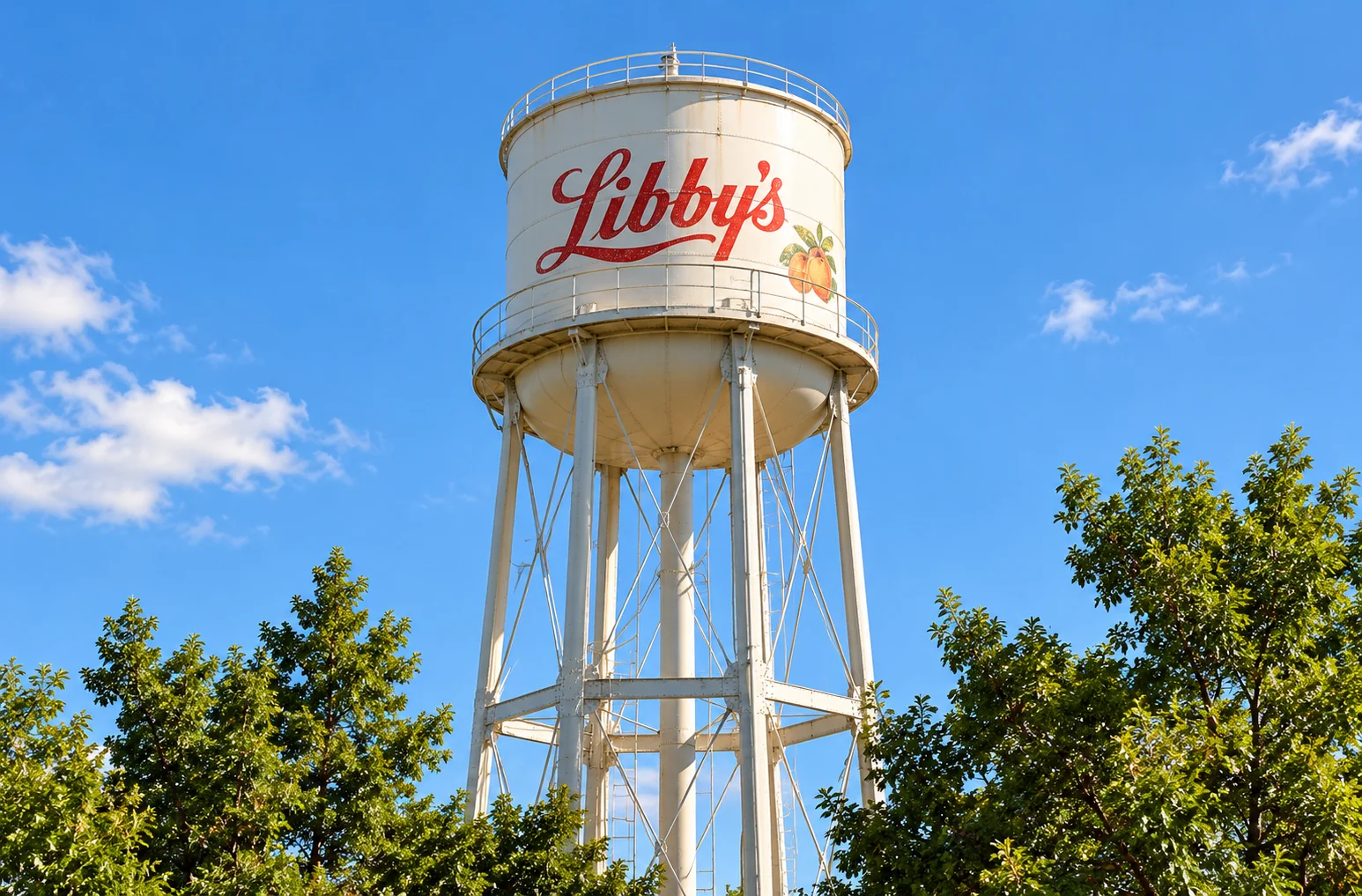
The Libby Water Tower looks playful: a fruit label lifted above the city on a framework of steel. Yet the story behind the Libby Water Tower is about practical infrastructure, factory work, and the changing value of industrial land. Its familiar appearance provides a way into a Sunnyvale that processed fruit as well as grew it.
Understanding the landmark means separating several histories. The cannery, the original water supply, the surviving tower, and its painted label did not all begin at the same time. Each belongs to a different chapter, and recognizing those chapters makes the structure more interesting.
The Cannery Came Before the Surviving Tower
The City’s heritage plaque, transcribed with a photograph by Read the Plaque, dates the opening of Libby, McNeill & Libby’s Sunnyvale cannery to 1907. It credits the operation with becoming the world’s largest cannery by 1922 and explains that an earlier tower supplied water to the cannery and its workers.
Importantly, the same plaque dates the replacement tower to 1965. The surviving structure is therefore not the original water tower from the cannery’s earliest years. A photograph of today’s landmark should not be captioned as though the complete structure had stood unchanged since 1907.
Why Separate the Dates?
Historic sites often combine objects from different periods. A business may be older than its buildings, and a building may be older than its most recognizable decoration. Here, distinguishing the cannery’s opening from the tower’s replacement helps readers understand industrial change rather than imagine a frozen scene.
The Label Has Its Own Timeline
The Sunnyvale Heritage Park Museum’s history of local public art describes a fruit-cocktail design painted on the tower in the 1970s. It also credits artist Anita Kaplan with a later repainting based on a 1930 label. That artwork recalls an earlier package; it does not date the tower itself.
Why Water Belonged at the Center of the Story

The plaque’s description of the original water supply brings attention back to the factory. Before the tank became a landmark, it served a practical purpose. Looking at the elevated container and supporting framework encourages a different question from simply asking what the label represents: what did this structure allow the workplace to do?
Do not assume its historical role establishes its present operating condition. The existence of a surviving tank does not, by itself, tell us whether it currently stores water, what equipment remains connected, or how it is maintained. Those questions require current owner or project documentation.
From Growing Fruit to Processing It
A cannery connects agricultural production with an industrial workplace. University of California’s apricot overview distinguishes fresh sales, canning, and drying as different uses of the crop. Following those routes makes clear why the history of fruit extends beyond the boundaries of an orchard.
Our article Why Apricots Matter to Sunnyvale begins with the trees. The water tower offers the next perspective: the buildings and equipment associated with processing. Together, the subjects connect fields, workplaces, and products rather than separating agriculture from industry.
The Workers Behind the Recognizable Label
A large label tells us which company wanted to be recognized. It tells us much less about the people who worked there. To build a fuller history, look for evidence of individual jobs, hiring practices, seasonal schedules, and experiences outside the factory.
Photographs can help, but their limits matter. A group picture might establish who stood together on one occasion without showing how work was organized throughout the year. An advertisement might show the labor a company sought without proving how many applicants were hired. Pairing different records produces a stronger account.
The Heritage Park Museum’s collection description includes cannery tools among its materials on Sunnyvale’s businesses and industries. Such objects provide a useful counterpoint to corporate branding: a tool directs attention toward a task, the skill it required, and the person who performed it.
For another perspective on employment and community life, explore Joshua Hendy Iron Works and Sunnyvale’s Working Life. Comparing industries can reveal different experiences without assuming every local workplace operated in the same way.
What Preservation Keeps, and What It Cannot

The museum’s account explains that the tower survived the cannery site’s redevelopment as an office park. Its survival created a visible connection to an earlier use, even as the surrounding setting changed. That relationship is part of the landmark’s meaning: viewers encounter industrial memory within a later landscape.
Preserving one structure cannot preserve an entire workplace. A tower does not reproduce production rooms, daily routines, sounds, or relationships among employees. Its value is not that it tells everything. Its value is that it gives people a recognizable starting point for finding the larger story.
Why the Surroundings Matter
A close photograph emphasizes the painted tank. A wider photograph records its relationship to buildings, paths, trees, and open space. Both views are useful, but they answer different questions. When documenting the site, keep the date and viewpoint with the image so later readers can understand what changed.
The City’s Peery Park Specific Plan Amendment materials identify a proposal involving relocation of the historic tower. The state environmental-review notice describes a potential move elsewhere on the Sunnyvale Business Park property. These are planning proposals, not evidence that a move has occurred; check the project record for subsequent decisions.
How to Look More Closely
Begin with the plaque, then compare what it says with what is visible. Note separately the cannery’s dates, the tower’s construction date, and the periods represented by its decoration. Photograph from an accessible location, respect property restrictions, and avoid treating online visitor descriptions as permission to enter restricted areas.
Keep a simple record of your sources as well. A plaque photograph, a museum account, and a planning notice serve different purposes. Recording who produced each source and when makes it easier to explain apparent differences instead of quietly merging them into one confident but misleading timeline.
The Libby Water Tower matters because an everyday industrial necessity became an enduring invitation to ask questions. Its label attracts attention, but the history behind it reaches into water infrastructure, fruit processing, working lives, and preservation. The most rewarding view is the one that connects the recognizable can with the less visible city that surrounded it.