
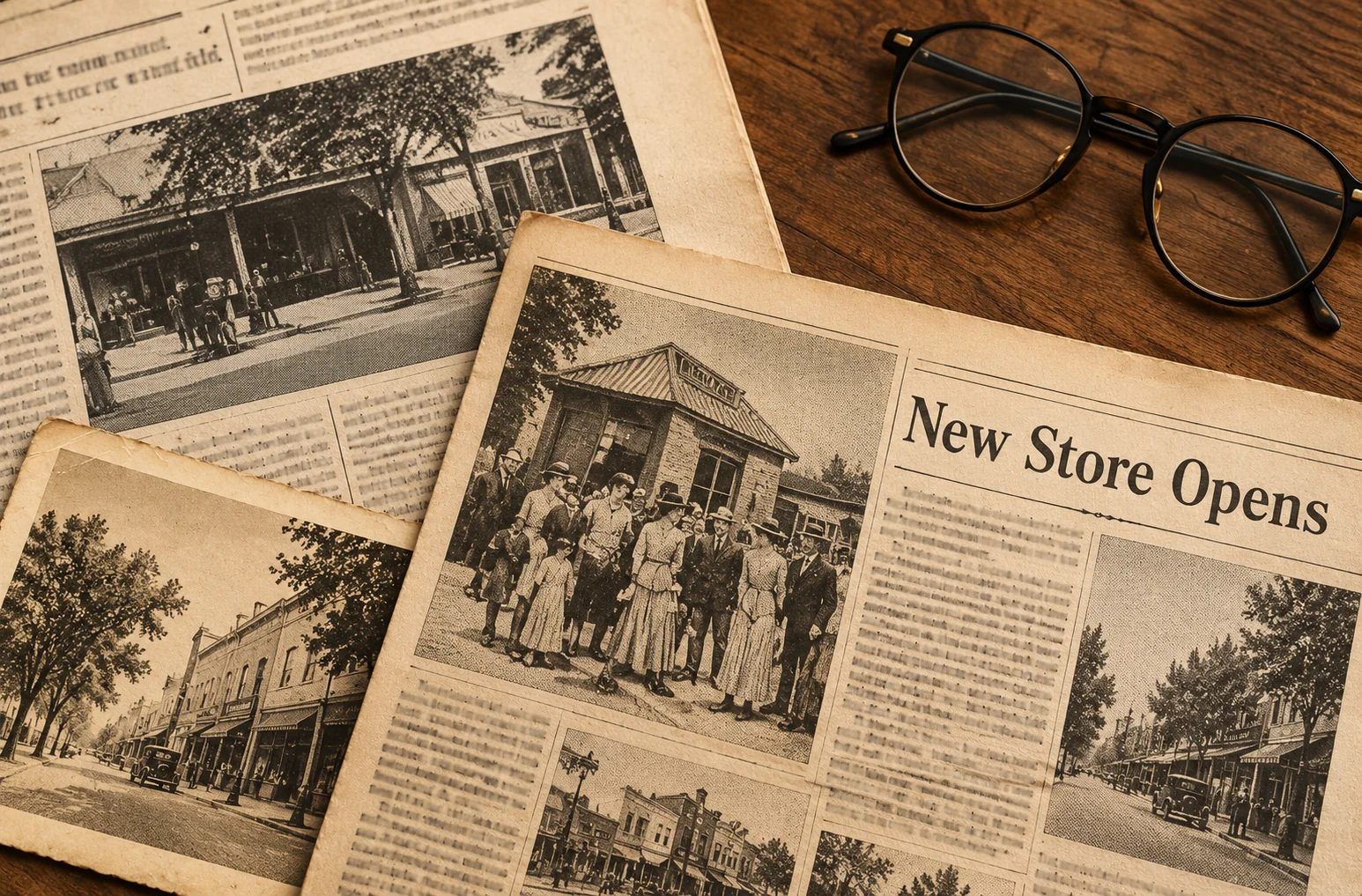
An old advertisement can look like a small distraction beside the news. For a local-history reader, it may be the most useful item on the page. A business address, an employment offer, or a promise of convenient shopping can reveal how a community imagined its needs and organized everyday life.
Old newspaper ads do not provide a complete picture of Sunnyvale, and their claims should not be taken at face value. They are persuasive documents. Read carefully, however, they can help connect people, workplaces, and familiar streets with the choices available at a particular moment.
Begin With the Newspaper, Not Just the Advertisement
A clipped advertisement loses information when it is separated from its newspaper. Before interpreting it, record the publication title, issue date, page number, and source collection. Check whether it appeared in a local newspaper or in a publication reaching a different audience.
Sunnyvale Public Library’s local-history resources include digitized newspapers covering 1908 to 1963. The library distinguishes access to its complete collection from access to newspapers published before 1963. Use its current links to check where the material you need is available.
What Was the Advertisement Trying to Achieve?
Ask whether the advertiser wanted readers to buy, apply, attend, subscribe, or move. That purpose shapes both the information supplied and the information omitted. An opening announcement might emphasize novelty, while a recruitment advertisement might present a workplace in its most favorable light.
A Promise Is Evidence of a Claim
An advertisement offering excellent wages establishes that the advertiser made that promise. It does not establish actual earnings, job security, or working conditions. The Library of Congress’s introduction to primary sources encourages considering purpose, audience, and corroborating evidence rather than accepting a single document as the whole story.
Addresses Can Rebuild a Commercial Neighborhood

A shop address is an excellent starting point because it can connect an advertisement to other kinds of records. Write down the wording exactly, including street names, abbreviations, and references to nearby landmarks. Then compare the location with a contemporary directory or map.
The Library of Congress holds Sunnyvale’s October 1911 Sanborn map set. A map from the relevant period can help place an advertised business within a block, although the map’s coverage and purpose must be considered. Do not assume an address has retained the same numbering or building configuration.
Once several locations are identified, compare them. Were related businesses nearby? Did advertisements emphasize proximity to transportation? Which services appeared around the same intersection? These questions turn isolated notices into a more useful picture of commercial relationships.
Our article on Murphy Avenue then and now shows how street-level research can connect visible buildings with earlier uses. Newspaper advertising supplies another layer, including the language businesses used to describe themselves.
Job Advertisements Connect Work With Family History
Employment notices can be particularly revealing because a workplace’s search for labor may connect with a family’s decision to relocate. The Heritage Park Museum’s Stowell family history recounts that Dolly Williams moved from Iowa to Sunnyvale in 1925 after her father answered a Joshua Hendy Iron Works advertisement seeking experienced machinists.
That is a retrospective historical account, not a transcription of the original advertisement. The distinction matters. To reconstruct the advertisement itself, a researcher would still need to locate the newspaper issue, inspect the wording, and record its publication details.
The example suggests a productive research path: connect an employer’s name with occupation, migration, schooling, and neighborhood life. A short notice can become the beginning of a larger story, provided each connection is documented rather than supplied by imagination.
Read Requirements as Carefully as Benefits
When an advertisement lists qualifications, working hours, or application instructions, preserve those details. They may raise questions about who was encouraged to apply and who was excluded. Avoid assuming the absence of an explicit restriction proves equal access; an advertisement is only one part of the employment record.
Prices and Products Need Context

A low historical price is eye-catching, but comparing it directly with today’s price rarely explains affordability. First check what the advertisement actually offered: the quantity, product size, payment terms, and any conditions. A headline price might require a larger purchase or exclude part of the cost.
To investigate affordability, look for earnings and household-cost evidence from the same place and period. Even then, distinguish a typical experience from one person’s experience. A price tells us what was advertised; it does not tell us how many households bought the item.
Visual choices deserve attention too. Is a product presented as economical, modern, respectable, or convenient? Which people appear in the illustration, and what are they shown doing? Treat these as clues about the advertiser’s message, not proof that every reader shared its values.
Avoid the Traps of Digital Searching
Searching digitized newspapers is useful, but a missing result does not prove an advertisement never existed. The Library of Congress’s newspaper research guidance explains that searchable text is generated through optical character recognition, which can misread small print, unusual lettering, and damaged pages.
Try alternate business names, shorter search terms, and nearby dates. When a likely issue is available, inspect the page image rather than relying entirely on extracted text. Check neighboring columns and pages; a cropped search result may omit conditions or part of an illustration.
Turn a Discovery Into a Reliable Local Story
Keep the full page as well as your working crop, and maintain a short note explaining what the advertisement establishes and what remains uncertain. Follow the Library of Congress’s citation guidance so another reader can locate the same item.
Before publishing the image, check its reuse conditions. The Library’s copyright guidance for primary sources cautions that online availability does not automatically mean unrestricted reuse.
A manageable first project is to follow one business through three dated advertisements. Record what changes and what stays the same: its address, name, products, and sales message. This small comparison is more informative than assembling unrelated advertisements simply because they look old or entertaining.
For a larger project, use our guide to researching Sunnyvale neighborhood history. An old advertisement becomes especially valuable when it can be connected with another record. Its smallest details may open the most interesting questions about how people worked, shopped, and understood the city around them.